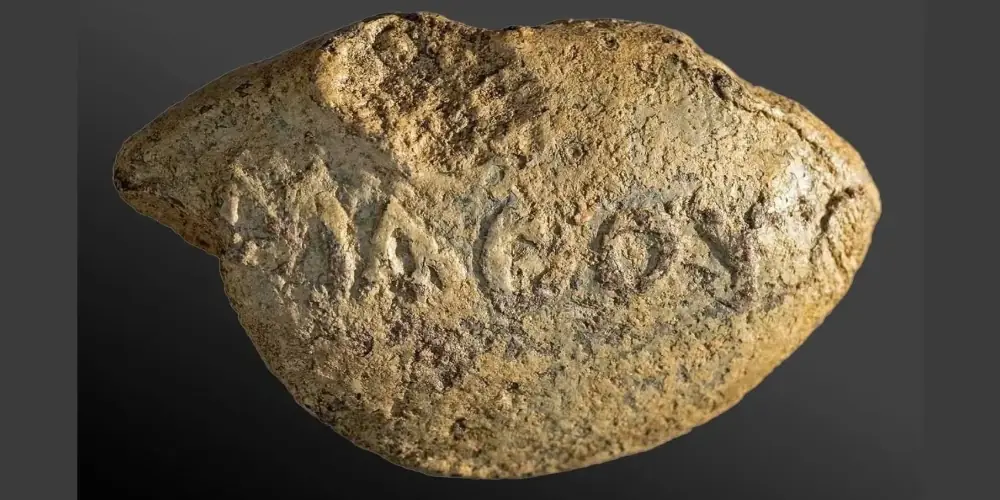
A tiny lead projectile found at the ancient city of Hippos is raising questions about how soldiers used humor and insults during warfare. The 2,000-year-old sling bullet carries a single Greek word meaning “learn.”
It is the first inscribed sling bullet discovered at the site, giving archaeologists a rare look at the personal messages used in ancient battles.
A Rare Find at Hippos
Hippos stood above the Sea of Galilee in what is now the Golan Heights. The ancient city saw several conflicts during the Hellenistic period, leaving behind weapons, ammunition, and other traces of warfare.
Last year, a University of Haifa team used metal detectors near a riverbed at Hippos. The search produced the small lead projectile. Researchers later identified a Greek inscription on its surface that translates as “learn.”
The team published its findings this month in the journal Palestine Exploration Quarterly. Lead author Michael Eisenberg, an archaeologist at the University of Haifa, believes the word may represent a shortened version of a mocking phrase such as “Learn your lesson.”
Eisenberg described the message as “local sarcastic humor” from Hippos’ defenders. The phrase may have been intended to taunt an approaching enemy while delivering a clear warning.
What Was a Sling Bullet?
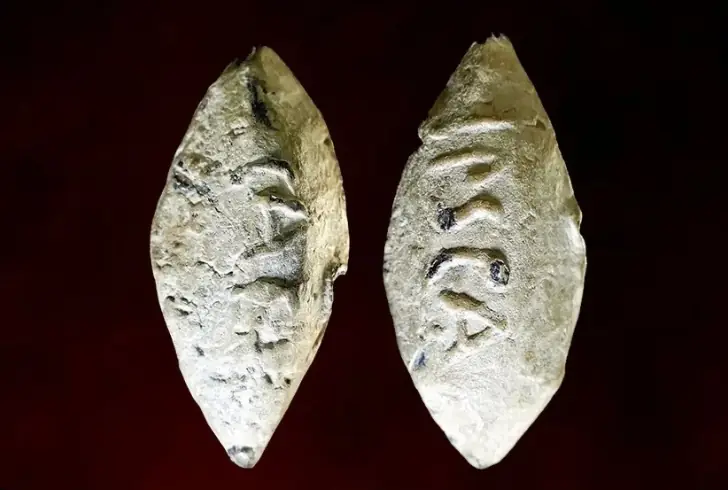
Sling bullets were small projectiles designed to be launched with a sling. Early examples used stone or clay, but lead became common during the Hellenistic period.
A fighter placed the projectile inside a leather pouch and swung it at high speed before releasing it. Lead made the ammunition compact and heavy, which also makes it easier for modern metal detectors to locate.
“We use metal detectors very frequently next to our excavation areas,” Eisenberg told Phys.org’s Sandee Oster. “Sling bullets are among the easiest to find with a metal detector due to their lead mass.”
Researchers have recovered 69 sling bullets at Hippos. Most date to the second century B.C.E. However, the newly discovered piece stands apart because it contains an inscription.
A Message With a Sharp Meaning
Inscribed sling bullets are not unique to the ancient world. Archaeologists have found examples carrying phrases such as “Take a taste” and “Receive this.” The Hippos inscription, however, appears to have a different tone.
The Greek word for “learn” may suggest a longer message that is no longer written on the bullet. Eisenberg told the Times of Israel that it could have meant, “Learn your lesson” or “Next time, you should learn not to come here.”
Ancient Greek grammar adds another layer to the inscription. The verb uses the middle voice, a form in which the subject both performs and experiences an action. Researchers suggest this wording could have strengthened the idea that the target needed to “draw his lesson” personally.
That unusual grammatical choice may have made the insult more pointed. Instead of simply telling an enemy to learn, the message may have suggested that the victim should learn from the attack.
Which Battle Used the Bullet?

The exact battle remains unknown. According to the researchers, the projectile could have been used during one of several conflicts involving Hippos during the Hellenistic period.
Before Hippos became an established city, a fortress occupied the hill under Ptolemaic rule. The site changed hands during the Battle of Paneion around 199 B.C.E., when the Seleucids defeated the Ptolemies. The Seleucids later established the polis of Hippos at the location.
Researchers believe the inscribed bullet was probably fired from within the city, possibly toward an approaching army. An examination also indicates that the projectile struck something after it was launched.
“We don’t know if it was a rock or a person, but there was definitely an impact,” Eisenberg told the Times of Israel.
What the Inscription Reveals
The small projectile offers more than evidence of ancient combat. Its single word hints at the attitude of the people who used it. Soldiers did not always treat ammunition as purely functional. Some projectiles carried jokes, threats, or insults aimed at the enemy.
The Hippos bullet adds a new example to that record. Its unusual Greek wording also shows how a short inscription could carry a sharper meaning than its size suggests.
The discovery connects archaeology, ancient language, and military history in one small object. Its exact target and battlefield remain uncertain, but the inscription provides a rare glimpse into the human side of warfare around 2,000 years ago.
At just over an inch long, the lead bullet survived with a message that still invites interpretation. Whether “learn” meant “learn your lesson” or warned an enemy never to return, the wording suggests that ancient combat could include a pointed sense of humor.