The story of how vertebrates first moved from water to land has taken an unexpected turn.
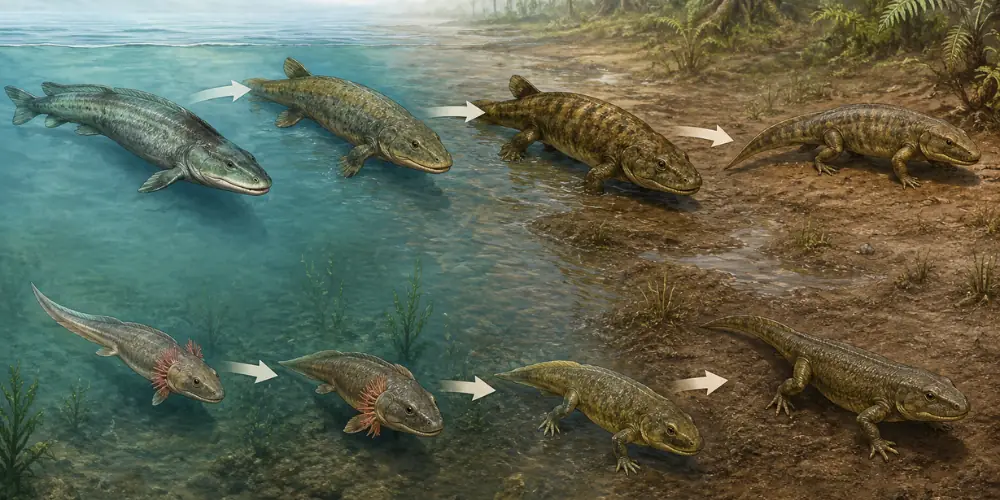
New fossil evidence suggests that some of the earliest relatives of land-dwelling animals did not experience an amphibian-like metamorphosis during development. Instead, these animals appeared to hatch looking much like miniature versions of their adult forms.
The findings, published on June 18 in the journal “Science,” are prompting scientists to rethink a concept that has appeared in biology textbooks for decades.
New Clues From Ancient Hatchlings
The transition from water to land marked one of the most important events in vertebrate evolution. It led to the rise of tetrapods, the group that includes reptiles, amphibians, birds, and mammals. For many years, scientists believed that the earliest vertebrates to make this transition passed through a larval stage similar to that seen in modern amphibians.
In living amphibians, metamorphosis involves a rapid developmental shift. Young animals lose features such as external gills and tail fins while developing stronger limbs and larger lungs as they adapt to life beyond the water.
According to evolutionary biologist Laura Porro of University College London, who was not involved in the research, scientists largely assumed that “this metamorphosis is ancestral to all terrestrial vertebrates.”
The new evidence, however, strongly challenges that view. Porro noted that the study “pretty conclusively shows that it’s not.”
What the Fossils Revealed
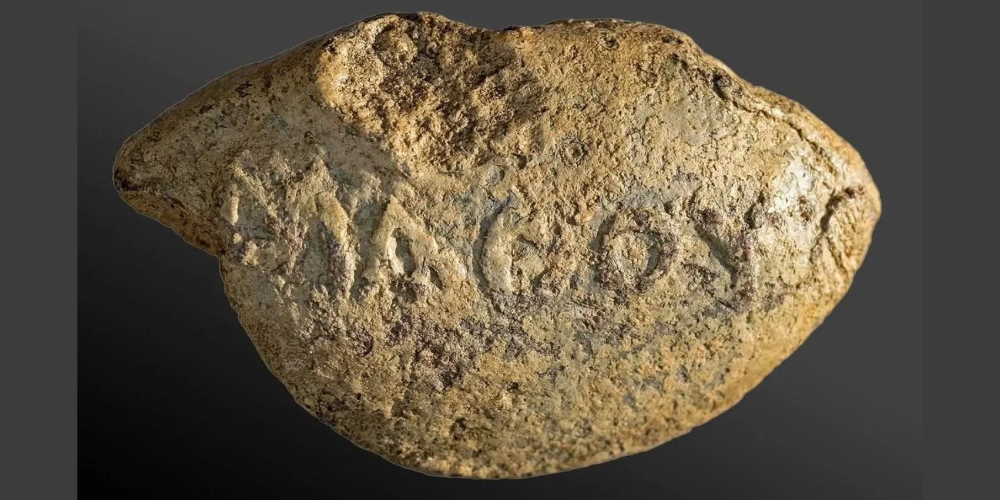
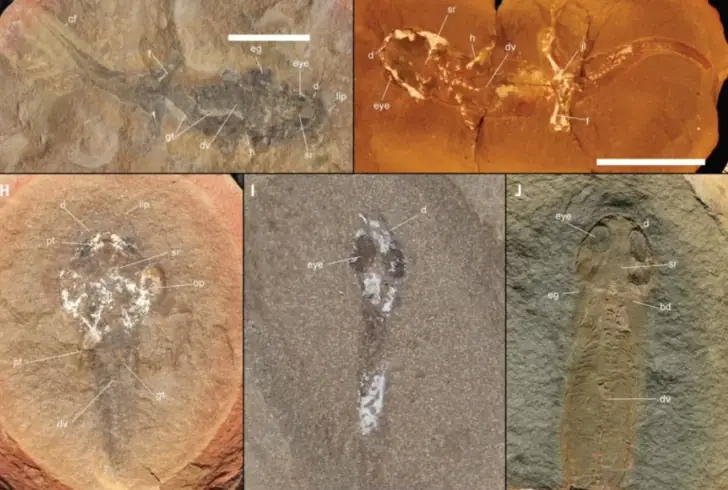
Paleontologists Jason Pardo and Arjan Mann of the Field Museum in Chicago examined fossils of newborn early tetrapods discovered in Mazon Creek, Illinois. These fossils are approximately 308 million years old and are exceptionally well preserved.
Using scanning electron microscope imaging, the researchers studied delicate structures, including skin and cartilage. The fossils belonged to animals that died shortly after hatching, making them valuable records of early development.
What stood out was what the fossils lacked. None showed signs typically linked to an amphibian-like larval stage. Features such as external gills and certain undeveloped skeletal elements were absent.
“We’ve got a pattern of none of these animals having anything that looks like a larval stage, let alone metamorphosis,” Pardo explained.
Three Different Species, One Pattern
The study examined hatchlings from three distinct groups, strengthening the overall conclusion.
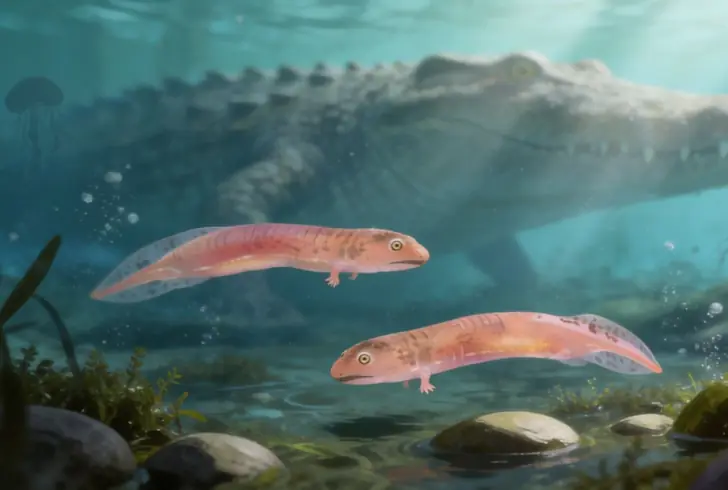
One of the animals was an embolomere, a large predator that lived during the Carboniferous Period, roughly 360 million to 300 million years ago. These creatures spent much of their time in lagoon-like aquatic environments, although their short limbs allowed them to move onto land when needed.
Pardo described them as “kind of like a cross between a crocodile and an eel.”
Researchers analyzed two tiny embolomere fossils measuring only one to two centimeters in length. One specimen still contained an internal yolk sac, which supplied nutrients before the animal began feeding independently.
“The fact they still have a yolk sac suggests that these are very, very young animals,” Porro said.
The second animal was a megalichthyid, a fish-like species that shared several skeletal characteristics with later tetrapods. The third was an aïstopod, a snake-shaped tetrapod that had lost its limbs through evolution rather than being a true snake.
Breathing and Development Questions
Evidence from adult embolomere skeletons suggests these animals likely possessed lungs for breathing air. They may also have had bony structures that supported internal gills. Scientists are still uncertain whether newly hatched individuals relied on internal gills, breathed air, or used a combination of both methods.
The megalichthyids also appear to have possessed internal gills alongside lungs. Aïstopods likely had lungs as well, and some researchers have proposed that they may have been capable of breathing through their skin, similar to certain modern amphibians.
Together, these species provide a rare glimpse into early tetrapod growth and development. Porro believes the diversity of the fossil sample strengthens the findings, stating, “I think what makes the case so strong is it’s got those three different groups.”
A New View of the Move Onto Land
The earliest known relatives of tetrapods capable of moving across land lived around 375 million years ago. Even older fossilized trackways suggest that excursions onto land may have begun earlier than the body fossils indicate.
Although the animals examined in this study lived millions of years later, they belonged to ancient evolutionary lineages that survived into later periods. This connection suggests that their ancestors may also have developed without passing through a dramatic metamorphic stage.
Many questions remain about how vertebrates first established themselves on land and reshaped ecosystems across the planet. Scientists still do not know how many separate times this transition may have occurred or how different groups adapted to terrestrial environments.
What is becoming clearer is that metamorphosis was not necessarily a requirement for early land vertebrates. The fossil evidence points to a developmental path that differed from long-standing assumptions.
As a result, a key chapter in vertebrate evolution is being rewritten. Porro believes the impact will be lasting, noting that “I think that’s going to be written into future textbooks.”