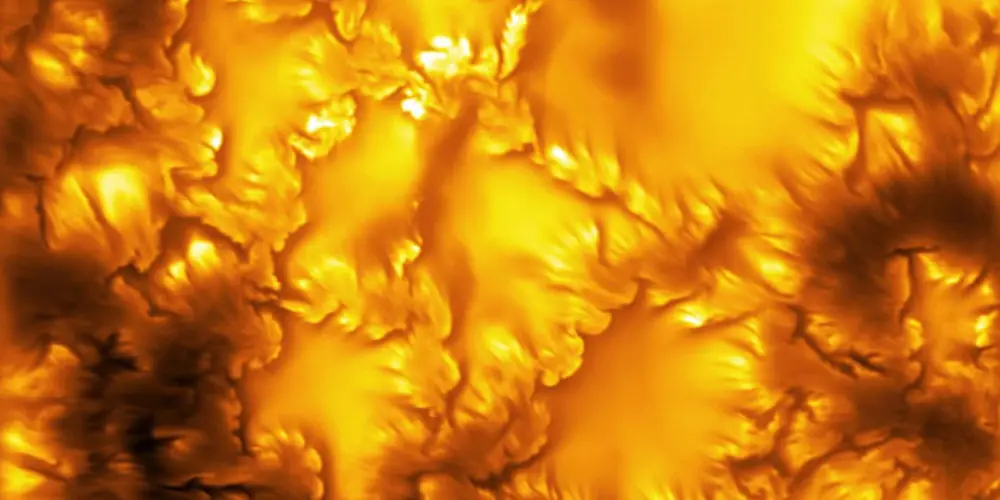
The Sun may look like a smooth, glowing disk from Earth, but its surface is filled with complex motion. A new observation from the U.S. National Science Foundation’s Inouye Solar Telescope has captured the sharpest view yet of the solar surface, revealing swirling patterns linked to a little-seen process in solar plasma.
An international research team used observations from the Inouye Solar Telescope to study fine structures across the Sun’s photosphere, the visible layer of its atmosphere. The team included researchers from the National Solar Observatory, the NSF National Center for Atmospheric Research High Altitude Observatory, and Germany’s Max Planck Institute for Solar System Research.
The images showed unusual swirling structures near the boundaries of magnetic regions. Researchers identified these patterns as signs of Kelvin-Helmholtz instability (KHI), a fluid instability that can occur when layers of fluid or plasma move at different speeds.
Why the Patterns Matter
Kelvin-Helmholtz instability has long been considered possible on the Sun. However, directly identifying its signatures in the solar photosphere provides a closer look at how solar plasma moves and interacts with magnetic fields.
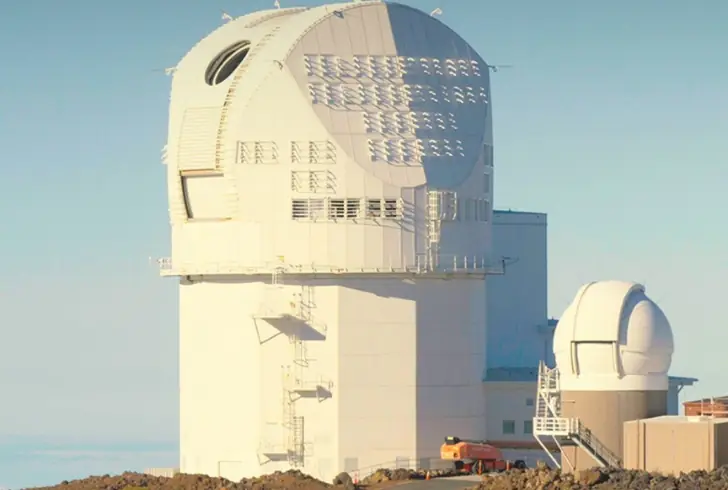
The observations are especially useful because the Inouye Solar Telescope can resolve extremely small features on the Sun. Time-lapse observations also show the plasma motion, giving researchers a clearer picture of the process rather than relying only on still images.
The finding could help scientists better understand how energy and motion develop within the Sun’s atmosphere. Since similar plasma processes occur in other stars, the research may also provide useful clues about stellar activity beyond the Sun.
Researchers’ View
David Boboltz, deputy director at the National Solar Observatory, described the finding as an important advance in studying solar and stellar plasma.
“We believe that the discovery of Kelvin-Helmholtz Instability in the solar photosphere, backed up by analysis of numerical simulations, is a major step forward in our understanding of the dynamics and evolution of solar and stellar plasma, and will serve as a basis for future discoveries,” Boboltz said in a statement.
The new observations turn tiny surface swirls into valuable evidence about the Sun’s physical behavior. By combining high-resolution imaging with numerical simulations, researchers can examine how magnetic fields and moving plasma interact.
The sharp solar images offer more than a detailed look at the Sun. They provide direct evidence of Kelvin-Helmholtz instability in the photosphere and give scientists a clearer way to study the forces shaping solar activity.