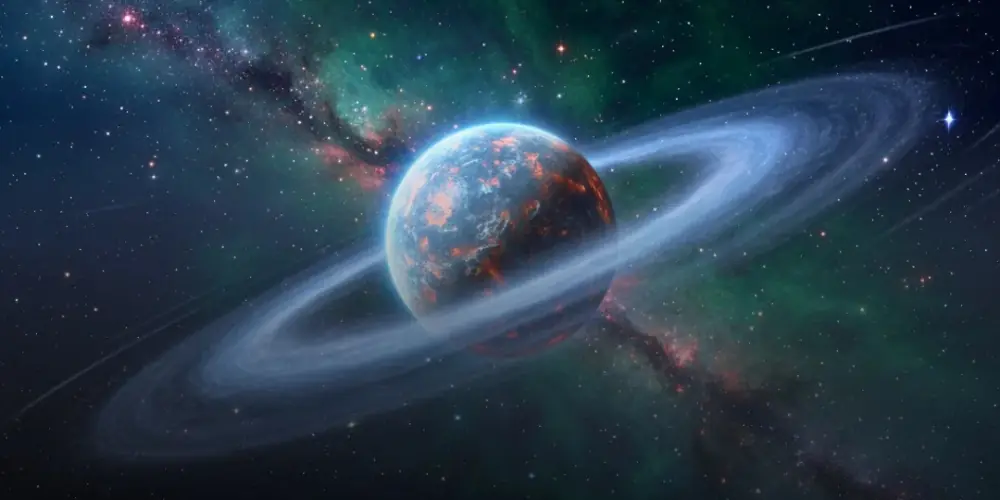
Far beyond the edges of the solar system, in the quiet darkness of the Chamaeleon constellation, astronomers have uncovered an extraordinary phenomenon. A rogue planet, one that drifts freely through space without orbiting a star, is growing at a rate that defies everything scientists thought they knew about planetary formation.
Known as Cha 1107-7626, this massive, young planet sits 620 light-years from Earth and appears to be gulping down gas and dust at a rate of 6.6 billion tons every second. Researchers describe it as a “cosmic infant with a star’s appetite.” The discovery, published in The Astrophysical Journal Letters, offers a rare, vivid look into the early, chaotic stages of planetary growth.
The Birth of a Giant
Cha 1107-7626 has a mass estimated to be between five and ten times that of Jupiter, the largest planet in the solar system. Yet compared to our 4.5-billion-year-old planets, it’s barely a million years old. Astronomers classify it as a “rogue planet,” one that doesn’t circle a star but instead wanders alone through interstellar space.
Using the European Southern Observatory’s Very Large Telescope in Chile’s Atacama Desert and NASA’s powerful James Webb Space Telescope, scientists observed that the planet’s growth rate spiked dramatically. In a matter of months, it began swallowing material eight times faster than before, a sudden growth surge unlike anything previously seen in planetary science.
As coauthor Aleks Scholz of the University of St. Andrews explained, Cha 1107-7626 is surrounded by a dense disk of gas and dust that constantly feeds it. “We’ve essentially caught a newborn planet in the act of devouring its surroundings,” he noted. “It’s an incredible glimpse into how worlds like ours might have begun.”
A Growth Spurt Unlike Any Other
When the planet’s accretion rate surged, astronomers quickly realized they were witnessing something extraordinary. Lead author Víctor Almendros-Abad of Italy’s Palermo Astronomical Observatory described the event as “the most powerful planetary growth rate ever recorded.”
The increase wasn’t subtle. Between April and August, observations showed that Cha 1107-7626 transitioned from a calm, steady phase to a period of furious activity. Coauthor Ray Jayawardhana from Johns Hopkins University captured the moment vividly, saying, “We’ve caught this newborn rogue planet gobbling up its surroundings at a furious pace. It’s like watching a star being born, except this one never became a star.”
The Webb Telescope’s infrared data revealed striking chemical changes during this burst. Water vapor appeared in the surrounding disk, something unseen in previous observations. This discovery is especially significant because such chemical transformations had only ever been recorded around stars, not planets.
A Planet That Behaves Like a Star
This finding challenges long-held ideas about how planets and stars form. Traditionally, scientists believed stars form when massive clouds of gas collapse under gravity, while planets develop more gradually within the disks of those newborn stars. But Cha 1107-7626 doesn’t fit that mold.
Scholz and his team suspect this rogue planet might have formed the same way stars do, from the collapse of a molecular cloud rather than orbiting one. “This object most likely formed through the fragmentation of a gas cloud,” Scholz explained, “much like a star, just on a smaller scale.”
Its powerful magnetic field may also play a key role. The planet’s magnetic activity seems to control how much gas and dust falls onto its surface, mimicking the processes seen in young stars. This means planets, even those much less massive than stars, can still exhibit similar energetic behaviors.
What Astronomers Have Learned So Far
Scientists first discovered Cha 1107-7626 in 2008, but its behavior remained puzzling for years. Earlier data hinted at previous bursts of rapid growth, including one in 2016. These repeating episodes suggest that the planet might go through cycles of explosive feeding followed by quiet periods.
Aleks Scholz noted that each burst helps astronomers understand how isolated worlds evolve. “If we can figure out how long these events last and how often they happen,” he said, “we’ll learn how much they contribute to a planet’s total growth.”
The discovery also highlights the remarkable capabilities of modern telescopes. The James Webb Space Telescope was the first to detect detailed chemical shifts in such a faint, distant object, while the Very Large Telescope’s X-shooter spectrograph captured a wide range of light wavelengths, from ultraviolet to near-infrared, to analyze the planet’s changing environment.
What Makes Rogue Planets So Fascinating
Rogue planets like Cha 1107-7626 are celestial wanderers, traveling through space without a parent star. Their origins remain mysterious. Some may have formed in planetary systems and later been ejected by gravitational forces. Others, like this one, might have been born on their own, collapsing directly from clouds of gas and dust.
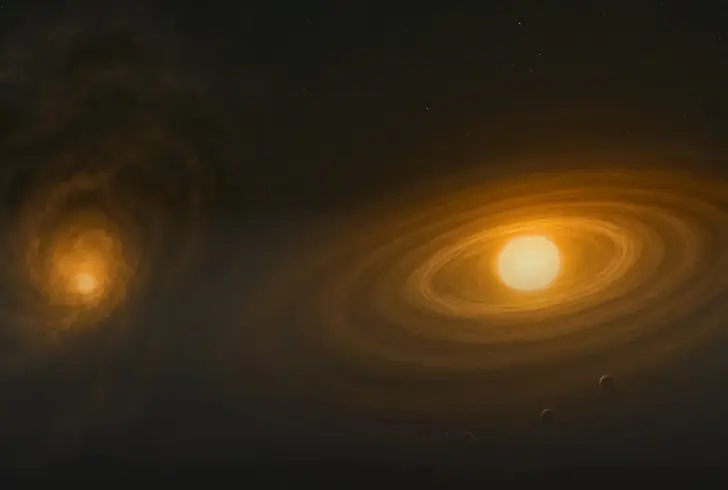
Dr. Jacco van Loon, director of the Keele Observatory in England, explained that the planet’s surrounding disk shows a complex molecular chemistry, similar to what’s found around young stars. “It makes one wonder,” he said, “what kind of moons might form in that material, and whether any could support atmospheres like Saturn’s moon Titan.”
This curiosity underscores a growing fascination with rogue planets. Because they drift in darkness, they’re notoriously hard to detect. Yet they could hold clues about how both stars and planets form, and about the potential for life in the universe’s loneliest corners.
Looking Ahead to New Discoveries
Future telescopes promise to reveal even more about these mysterious worlds. The upcoming Extremely Large Telescope (ELT) in Chile will offer enough power to study faint, free-floating planets in unprecedented detail. Meanwhile, the Vera C. Rubin Observatory and Nancy Grace Roman Space Telescope, launching later this decade, will help astronomers track rare outbursts like the one from Cha 1107-7626 across many similar objects.
According to Almendros-Abad, these new instruments will finally allow scientists to “build a statistical picture of how often these bursts occur and how much they shape a planet’s evolution.” With that knowledge, researchers may soon uncover whether such planets could host moons, or even primitive forms of life.
The Continuing Mystery of Cha 1107-7626
The story of Cha 1107-7626 is far from over. Every new observation challenges existing theories about how planets form, grow, and behave. Scientists now see that even isolated worlds, far from any star, can show star-like qualities, complete with magnetic storms and chemical transformations.
This discovery not only deepens the understanding of planetary birth but also blurs the line between stars and planets themselves. Somewhere in the cold void of space, a lonely planet continues to grow, glowing faintly as it feeds on the dust and gas that surround it.
And with every passing second, it becomes a little bigger, a little brighter, a living reminder that the universe is still writing its story, one mysterious world at a time.