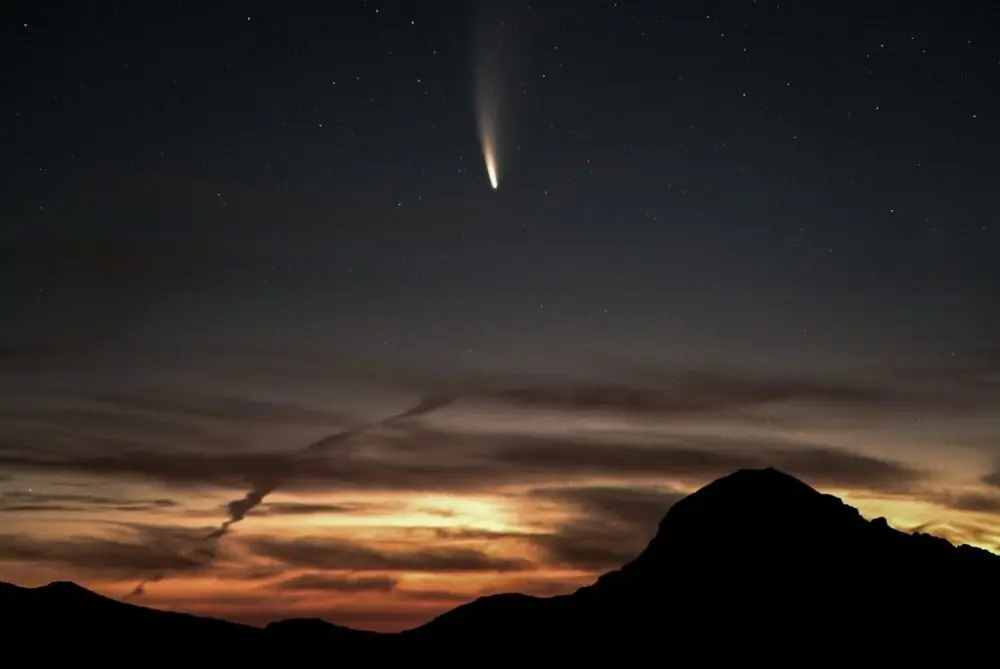
Have you ever gazed up at the night sky and wondered, “What does a comet look like?” You are not alone! Comets have fascinated humans for centuries, their bright, glowing tails often inspiring awe and curiosity.
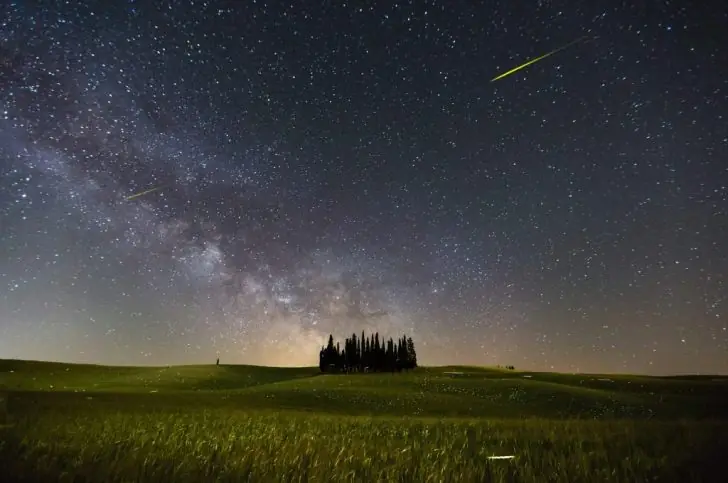
Essentially, comets are cosmic wanderers, large objects composed primarily of ice, dust, and rocky material. They are often described as “dirty snowballs” due to their icy composition mixed with dust and organic compounds.
These fascinating celestial bodies orbit the Sun in highly elliptical paths. Meaning, their journeys can take them from the outer reaches of the solar system to close encounters with the Sun and occasionally, Earth.
Where Do Comets Come From?
Comets originate from two main regions in the solar system: the Kuiper Belt and the Oort Cloud.
- The Kuiper Belt: This region lies beyond the orbit of Neptune and is home to many short-period comets. These comets complete an orbit around the Sun in less than 200 years.
- The Oort Cloud: This is a distant, spherical shell of icy bodies surrounding the solar system. It is the birthplace of long-period comets, which can take thousands or even millions of years to complete an orbit around the Sun.
What Does a Comet Look Like?
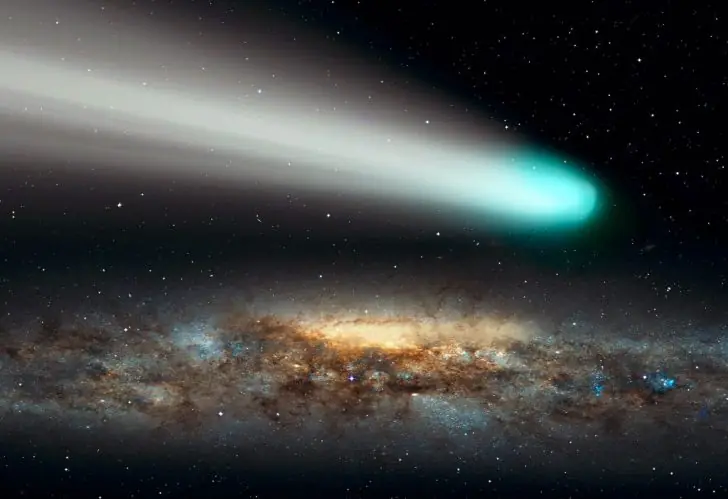
So, what does a comet look like? At first glance, a comet might appear as a bright, fuzzy spot in the night sky, often with a glowing tail. However, a comet is composed of several distinct parts, each contributing to its overall appearance.
What are the Six Parts of a Comet?
Nucleus
The nucleus is the solid, central part of the comet, typically ranging from a few hundred meters to tens of kilometers in diameter. It is made up of ice, gas, and dust, and is usually dark due to organic compounds on its surface.
Coma
When a comet approaches the Sun, the heat causes the ice in the nucleus to vaporize, forming a glowing cloud of gas and dust around it known as the coma. The coma can be hundreds of thousands of kilometers in diameter.
Hydrogen Cloud
Surrounding the coma, the hydrogen cloud is a vast envelope of hydrogen gas that can stretch millions of kilometers across. This part is not visible to the naked eye but can be detected by instruments.
Dust Tail
This is the part most people recognize. A glowing tail that streams away from the comet. The dust tail is formed by particles from the coma pushed away by the pressure of sunlight.
It curves slightly due to the comet’s motion.
Ion Tail
The ion tail, or gas tail, is made of ionized gases that are pushed straight away from the comet by the solar wind. Unlike the dust tail, the ion tail points directly away from the Sun and can appear bluish.
Antitail
Occasionally, a comet will display a third tail, known as the antitail, which appears to point towards the Sun. This is an optical illusion caused by the Earth passing through the plane of the comet’s orbit.
Why Do Comets Have Tails?
One of the most enchanting features of comets is their tails. But why do comets have tails?
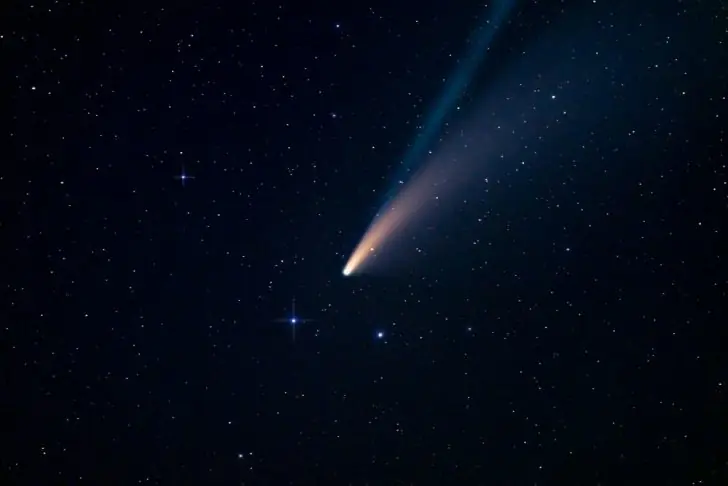
This process releases dust and gas, which are then pushed away from the comet by solar radiation and the solar wind, forming the characteristic tails.
What Brings Comets So Close to Earth?
Comets can be brought close to Earth by gravitational interactions with other celestial bodies, such as planets. These interactions can alter a comet’s orbit, sending it into the inner solar system.
Sometimes, these close encounters with planets, particularly Jupiter, can send comets hurtling towards the Sun or eject them from the solar system entirely.