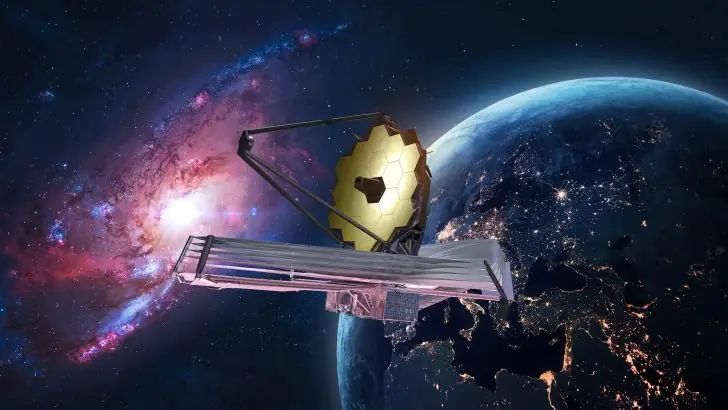
The Webb Telescope has discovered tentative signs of life beyond Earth, and the buzz in the science world is real. NASA’s most powerful telescope has detected gases on a faraway planet that, on Earth, only come from living things. Could this be the first clue that we are not alone?
While scanning a planet called K2-18 b, the James Webb Space Telescope (JWST) picked up something unusual. It spotted two rare gases, dimethyl sulfide (DMS) and dimethyl disulfide (DMDS), floating in the planet’s atmosphere.
On Earth, these gases don’t just hang around for fun. They are made by tiny sea creatures like algae. That is why scientists are calling them possible biosignatures, or signs of life.
K2-18 b is no Earth 2.0. It is a sub-Neptune, meaning it is much larger than Earth and has a thick, puffy atmosphere. It is about 8.6 times heavier than our planet and sits 124 light-years away, in the Leo constellation.
That is the sweet spot, not too hot, not too cold, where liquid water could exist. And water, as we know it, is life’s best friend. Add in those strange gases, and suddenly K2-18 b becomes a serious contender in the alien-life sweepstakes.
Scientists think K2-18 b might be a hycean world. That means it could have a vast ocean under a steamy hydrogen-rich sky. This type of planet hasn’t been proven yet, but it is a hot idea in exoplanet science. A deep, salty sea with a thick atmosphere might be just the kind of place microbes could thrive.
The Best Clue Yet
Still, no one is popping champagne just yet. The Webb Telescope discovers tentative signs of life beyond Earth, but scientists are being super cautious. The signal for DMS and DMDS has a confidence level of 99.7%. Sounds high, right? But in science, that is not enough to declare a discovery.
The gold standard is 5-sigma, which is 99.99994% sure. So, there is still a tiny chance this is just a blip.
The next step? Webb will keep its eyes on K2-18 b. More observations are on the way. Scientists want to double-check the gas readings and make sure they are not being fooled by background noise or other data quirks. This is too big to mess up.
At the same time, researchers will work on figuring out whether these gases could come from something non-living. Could the planet’s chemistry cook up DMS and DMDS without life being involved? That is the big question. If the answer is no, then the case for life gets a lot stronger.
The idea is huge, not because we have found aliens, but because it is the strongest lead we have ever had. For the first time, a telescope has spotted gases outside our solar system that, on Earth, only come from living things.
And if this turns out to be real, it is more than just a cool science headline. It would shake everything we thought we knew about our place in the universe. For centuries, we have asked if we are alone. This discovery might be the first step toward answering that.