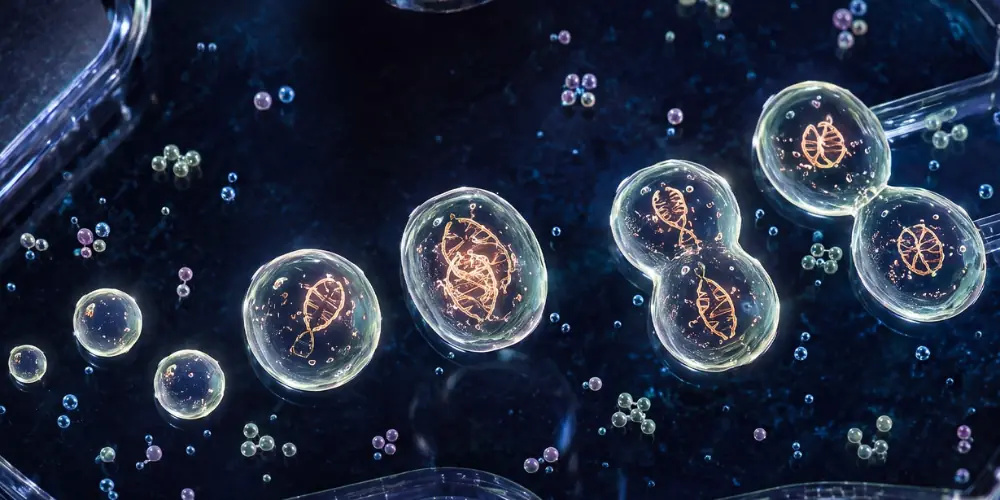
Creating life from non-living materials has remained one of biology’s biggest scientific goals for decades.
That idea has now taken an important step forward after researchers developed artificial cells that can consume nutrients, increase in size, reproduce, and even compete for resources. Although these engineered cells are not considered fully alive, they display several behaviors normally linked with natural living organisms.
The research offers fresh insight into how life functions at its most basic level and may eventually support advances in medicine, biotechnology, and synthetic biology.
A New Milestone in Synthetic Biology
A research team led by synthetic biologist Kate Adamala from the University of Minnesota introduced the artificial cells in a study published on the bioRxiv preprint server on July 2. The findings have not yet completed peer review.
The newly created cells perform several life-like activities. They absorb nutrients from their surroundings, grow larger over time, divide into new cells, and show limited competition for food. Even with these capabilities, the cells cannot independently build every internal structure needed for long-term survival, and they stop reproducing after only a few generations.
Speaking to The Guardian, Adamala explained, “It is not as robust, as fast or as good at most of its functions as a natural cell, but it is proof of principle that molecules can reconstitute behaviors that, up until now, we only associated with natural living cells.”
Roseanna Zia, a computational biologist at the University of Missouri who was not involved in the research, highlighted the significance of the work while speaking to The New York Times, saying, “We’re going to remember this moment.”
How the Artificial Cells Were Built
Scientists have spent many years trying to recreate living cells inside laboratories. Success in this area could improve the understanding of life’s basic mechanisms while also creating new ways to manufacture valuable biological compounds.
Synthetic insulin, for example, is already produced by genetically modified bacteria and yeast for people living with diabetes.
The research team first attempted to copy natural cell division by simplifying the process. Later, the scientists changed direction and adopted a bottom-up design strategy. Instead of modifying existing cells, they assembled each component individually to understand how every part contributed to cellular behavior.
The artificial membranes were designed to collect proteins from the surrounding environment. As protein levels increased, the membrane gradually bent inward until it divided into two separate structures.
Meet the “SpudCell”
The next phase focused on building an entire artificial cell from scratch.
Researchers started with tiny water-filled spheres enclosed by oily membranes known as liposomes. Into these structures, they inserted DNA carrying just 36 genes responsible for basic cellular functions.
Those genes came from a virus and the bacterium Escherichia coli. For comparison, a normal E. coli cell contains around 4,400 genes.
The finished structure received the name “SpudCell.” The unusual name reflects its potato-like appearance while also honoring both Sputnik and Kate Adamala’s Polish heritage. Adamala joked to The Guardian, “I’m Polish. I’m mostly made of potatoes.”
Feeding, Growing, and Reproducing
Inside laboratory flasks containing nutrient-rich chemical solutions, the SpudCells started displaying behaviors similar to living cells.
The artificial cells absorbed molecules such as adenosine triphosphate (ATP), which serves as the primary energy source for all known life. They also merged with specially designed feeder liposomes carrying larger biological materials, including enzymes needed for cellular activity.
As nutrients accumulated, the cells expanded in size. Within only a few hours, they reached the point where reproduction became possible. Researchers then introduced specialized proteins that caused the membranes to divide, producing new artificial cells that continued to grow.
The study also revealed an early form of evolutionary competition. Scientists compared the original SpudCells with a genetically altered version engineered to attach more effectively to feeder liposomes. Over five generations, the modified cells consistently outperformed the original population by collecting nutrients more efficiently.
John Glass, a synthetic biologist at the J. Craig Venter Institute in La Jolla, California, praised the achievement while speaking to The New York Times, saying, “It is dazzling that has put these things all together.”
Why the Cells Are Not Yet Alive
Despite their impressive abilities, SpudCells remain incomplete when compared with natural organisms.
One major limitation involves ribosomes, the structures responsible for producing proteins inside every living cell. Although the artificial cells contain genes associated with protein production, they cannot build ribosomes on their own.
Instead, researchers must provide working E. coli ribosomes through feeder liposomes. Even with this outside support, protein production gradually fails after approximately five to ten generations. As a result, the cells cannot maintain continuous reproduction without human assistance.
Because of these limitations, scientists do not classify SpudCells as fully living organisms.
Scientists Remain Divided
The research has generated excitement, but not every expert believes artificial life is close.
Seraphine Wegner, a biochemist at the University of Münster in Germany, described the study to Science as “a very cool paper,” but added, “I don’t think it means we’re close to creating a fully synthetic cell.”
John Dupré, a philosopher of biology at the University of Exeter in England, also questioned whether engineered cells would eventually outperform modified bacteria for producing medicines, food, fuels, or industrial materials.
According to The Guardian, he suggested that the work may contribute more to philosophical discussions about life than to practical manufacturing.
Dupré also noted, “It will, perhaps, provide a compelling argument against those who think there is some immaterial substance in addition to the chemicals that breathes life into material stuff. But almost no scientist now believes this.”
What Comes Next?
Although many scientific hurdles remain, researchers believe artificial cells could eventually perform tasks that natural cells cannot. Adamala hopes future versions may produce entirely new medicines or specialized biological compounds beyond the abilities of existing organisms.
To support continued research, Adamala has partnered with Stanford University synthetic biologist Drew Endy to establish the nonprofit organization Biotic. The initiative aims to encourage collaboration on artificial cell development and related scientific projects.
Endy compared the achievement to the Wright brothers’ first successful airplane flight in 1903. Speaking to The New York Times, he said, “The Wright Flyer flying for 12 seconds doesn’t get you a 737. This is just the beginning.”
SpudCells mark an important step in synthetic biology by showing that carefully designed chemical systems can perform several functions normally seen in living cells. While they still depend on external support and cannot reproduce indefinitely, the research offers valuable insight into how life works at its most basic level.
Future studies may lead to new applications in medicine, biotechnology, and a deeper understanding of the origins of life.