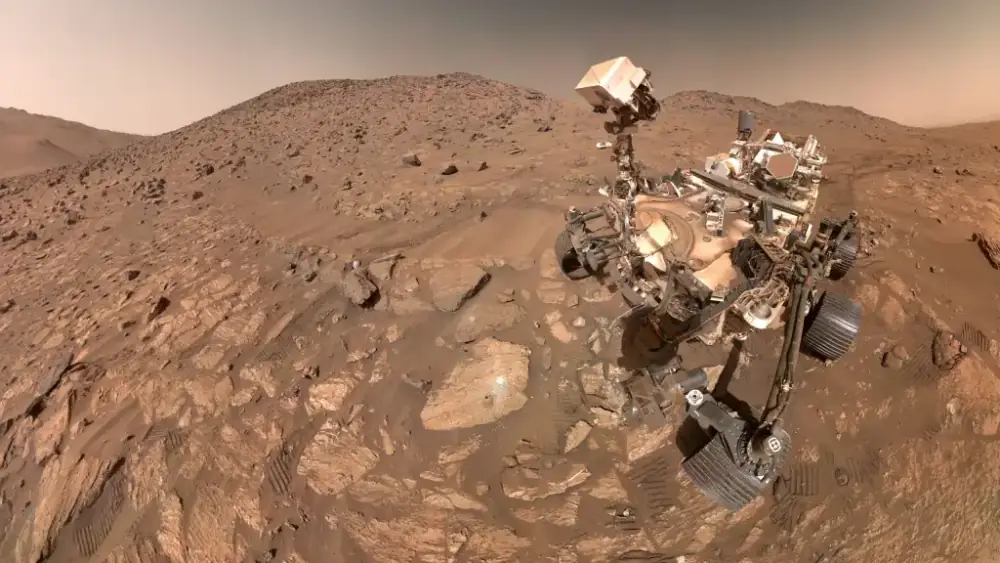
NASA’s Perseverance rover has found the strongest sign yet that ancient life may have once existed on the red planet, Mars. The discovery comes from a rock sample collected in July 2024, deep in a dry riverbed inside Jezero Crater.
That sample, named “Sapphire Canyon,” was drilled from a rock called “Cheyava Falls” in an area known as the Bright Angel formation. This used to be a lakebed, and it is packed with chemical ingredients that life on Earth thrives on. Now, scientists think the same might have been true for Mars.
These are the kinds of materials that don’t just pop up for no reason. On Earth, they almost always point to life.
However, that doesn’t mean Mars was once crawling with creatures. But it does mean something weird and possibly biological happened there long ago. The patterns in the rock, which look like “leopard spots” and “poppy seeds,” suggest slow, low-temperature chemical reactions. Here on Earth, these same kinds of reactions are often fueled by microbes.
Could It Be Non-Biological?
But here’s the catch. Minerals like vivianite and greigite can also form without life. They can appear due to heat, acidity, or other non-living processes. That is why scientists are careful. They’re not calling it proof. Not yet. But there is no sign of those harsh conditions in the Bright Angel rocks. That makes a biological origin way more likely.
The rock itself is a mudstone. That is important. Mudstones are great at preserving organic materials. They form in calm water, where particles slowly settle and lock in chemical clues. The ones at Bright Angel are loaded with organic carbon, sulfur, and oxidized iron – basically, food for microbes.
NASA published the findings in the journal Nature on September 10, 2025. That means the data passed peer review and is now out in the open for scientists everywhere to analyze. It is a big deal. This kind of vetting doesn’t happen unless the science holds up under pressure.
More Work is Needed, Scientists Say
Right now, this sample scores as a “potential biosignature.” That means it is promising, but more work is needed.
The discovery also shifts how we think about Mars. Most experts assumed any signs of ancient life would be buried in the oldest rocks. But this sample came from a younger part of the crater, suggesting Mars may have stayed habitable longer than we thought.
Sapphire Canyon is just one of 27 samples Perseverance has collected. To know for sure if this one contains real signs of life, scientists need to study it in labs back on Earth. But there is a problem. Bringing the rocks home isn’t easy.
NASA’s Mars Sample Return mission is supposed to do exactly that. But it is running into budget cuts and technical setbacks. That could delay the return of these priceless rocks for years. Some scientists are now pushing for faster, cheaper options, like partnering with other space agencies or building tools that can analyze the samples directly on Mars.