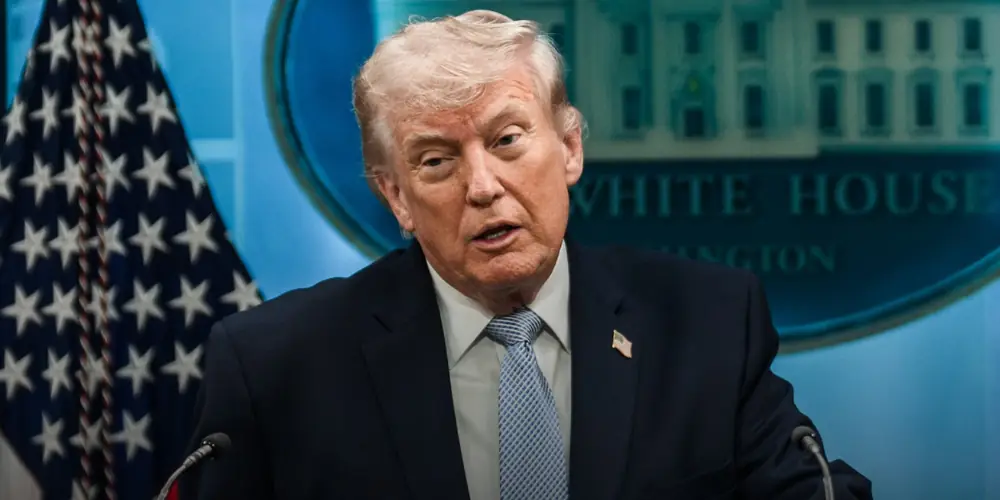
Donald Trump’s return to the White House in 2024 arrived with strong confidence from Wall Street. Investors leaned into expectations of lower corporate taxes and lighter regulation, both seen as fuel for stronger earnings growth.
That optimism showed up in the numbers, with the S&P 500 climbing 17.9% in 2025. Yet, the second year of the term has brought a different kind of pressure, shaped by global conflict, oil shocks, and stretched market valuations.
Markets have already absorbed policy uncertainty, including unpredictable tariff decisions and tension around independent institutions such as the Federal Reserve. Even so, the latest geopolitical strain involving Iran is raising fresh concerns that are harder to dismiss.
Energy Shock and Slower Growth Risk
A sharp rise in oil prices followed military strikes involving the U.S. and Israel targeting Iran. The country accounts for roughly 4% of global oil supply, but the bigger concern centers on the Strait of Hormuz. This narrow route handles close to 20% of global oil consumption, along with significant flows of natural gas and fertilizer.
Recent disruptions in the region, including blockades affecting the Strait of Hormuz, have intensified fears about global energy stability. When oil supply tightens, the impact spreads quickly through transportation costs, manufacturing, and household expenses.

History shows how damaging this kind of shock can be. During the 1973 Arab oil embargo and the 1978 Iranian Revolution, oil prices nearly doubled between 1979 and 1980. Those events contributed to stagflation, a difficult mix of high inflation and weak economic growth.
A similar pattern today would create pressure on monetary policy. Inflation limits the Federal Reserve’s ability to reduce interest rates, while high borrowing costs slow down business expansion and increase mortgage expenses. This combination often weighs on equity markets, as corporate profits face tighter conditions.
Stock Valuations Near Historical Extremes
While geopolitical risks build, stock valuations are already sitting at elevated levels. One widely used measure, the cyclically adjusted price-to-earnings ratio (CAPE), smooths earnings over a 10-year period to reduce short-term distortion.
At a level of 38, the S&P 500 is trading near territory last seen during the dot-com bubble in the early 2000s. That period ended with a steep correction as overly optimistic expectations around technology stocks reset.
Today’s high valuation environment is closely tied to enthusiasm around generative artificial intelligence. Large technology companies continue to invest heavily in advanced computing infrastructure, fueling strong momentum in the market.
At the same time, energy prices introduce a new challenge for this growth narrative. Rising costs make data center operations more expensive, which can slow expansion plans across the tech sector. Signals of caution have already appeared, including operational pullbacks such as OpenAI closing its video generation tool Sora, reflecting tighter attention on cost control and long-term risk.
Geopolitics and Market Direction
The path forward for global markets now depends heavily on how the Iran situation evolves. If energy routes remain disrupted, inflation could stay elevated, limiting the chance of rate cuts and keeping financial conditions tight.
In that scenario, speculative areas of the market often feel the pressure first. High-growth, unprofitable companies tend to rely on cheap capital, which becomes harder to access when interest rates stay elevated.
Still, oil-driven shocks do not always lead to sustained crashes. In some cases, rising prices push economies toward slower growth or recession, which eventually reduces demand and brings energy prices back down. That cycle can stabilize inflation but often arrives after a period of volatility.
Investor behavior also plays a role. Shifts toward defensive assets, including energy stocks, tend to increase during uncertainty. However, timing these moves consistently has proven difficult across market cycles.
Market Trends Across Political Cycles
Concerns about a potential stock market crash during Trump’s second term often center on policy unpredictability and global conflict. Even so, historical patterns show that markets react more strongly to economic conditions than to political leadership alone.
Sharp corrections have occurred under multiple administrations and across different economic environments. Despite these downturns, long-term market performance has consistently trended upward over extended periods.
Periods of decline have also created entry points for investors focusing on long-term accumulation rather than short-term timing. While volatility can be uncomfortable, it has remained a regular feature of equity markets across decades.
Stock market direction under Trump’s current term will likely depend on a mix of geopolitical stability, energy prices, inflation trends, and interest rate policy. The war-related strain in Iran, combined with elevated valuations and strong reliance on artificial intelligence-driven growth, has increased market sensitivity.
A crash is not guaranteed, but risks have clearly risen compared to the earlier phase of the rally. Even so, historical cycles show that markets tend to recover over time after major shocks. The focus for long-term investors remains on broader economic direction beyond short-term political and global disruptions.