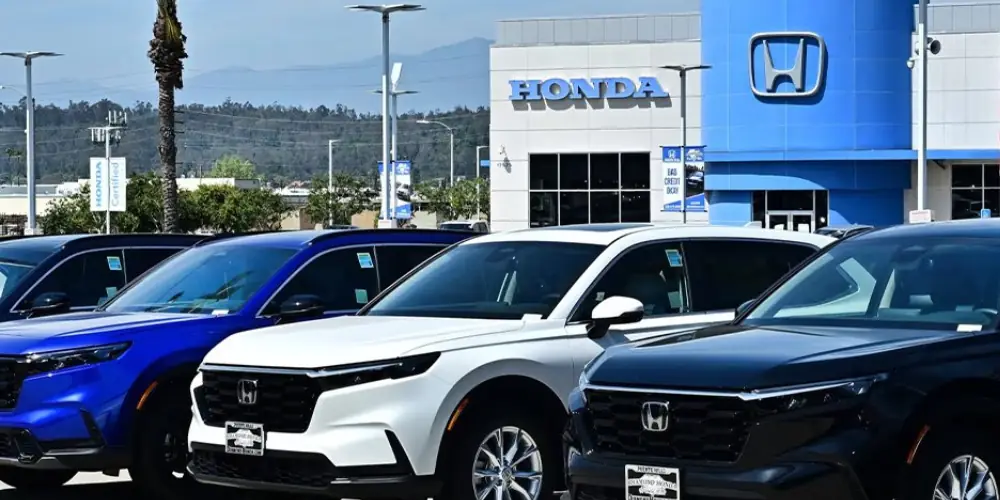
Honda has reported its first annual loss since 1955, marking a major shift for one of the world’s biggest automakers. The company’s financial setback reflects a wider struggle across the auto industry as manufacturers pull back from aggressive electric vehicle investments after policy changes in the United States reshaped the market.
For years, automakers spent billions preparing for a future centered on electric vehicles. That momentum slowed after the Trump administration rolled back stricter US emissions rules and removed the $7,500 federal tax credit for EV buyers.
Once the incentive disappeared in September, electric vehicle sales dropped sharply. Even rising gasoline prices failed to drive strong consumer demand for EVs.

Honda felt the impact heavily. The company revealed that it absorbed a 1.6 trillion yen hit, equal to nearly $10 billion, during its fiscal year ending in March. Without that charge, Honda could have posted a profit of around $7.4 billion. Instead, the automaker recorded a net loss of 403.3 billion yen, or roughly $2.6 billion.
The company also warned that another writedown tied to previous EV spending is expected in the current fiscal year, although executives indicated it likely will not trigger another annual loss.
Why Automakers Are Changing Course
Car companies originally prepared for tighter American emissions standards that were expected to push the market toward all-electric lineups over the next decade. Automakers invested heavily in battery plants, EV platforms, and production facilities to stay ahead of those regulations.
That strategy changed after the Biden-era emissions rules were scrapped and major financial penalties tied to emissions compliance disappeared. As a result, manufacturers shifted attention back to gasoline-powered trucks and SUVs, which continue to deliver stronger profit margins.
The return to traditional vehicle production, however, has come at a steep price. Companies are now forced to reduce the value of large EV projects that no longer fit current demand forecasts.
Honda is not alone in this reversal. General Motors reported a $7.2 billion charge in 2025 linked to scaling back EV operations. Ford disclosed a much larger charge of $17.4 billion, while Stellantis — the company behind Jeep, Ram, Dodge, and Chrysler — announced a massive 25.4 billion euro loss, equal to about $29.7 billion.
General Motors still managed to stay profitable despite the financial hit. Ford and Stellantis, however, both ended 2025 with net losses. Ford also signaled that additional charges are expected this year.
EV Competition Still Isn’t Going Away
Despite the retreat, automakers are not abandoning electric vehicles entirely. Tougher emissions policies remain in place across parts of Europe and Asia. Several US states, led by California, are also continuing efforts to phase out new gasoline-powered vehicle sales by 2035, although Congress has attempted to block that regulation.
At the same time, global competition continues to intensify. Chinese automakers, many of which focus heavily on EV production, are expanding rapidly. Their presence in the American market remains limited for now, yet established brands are closely watching their growth.
Honda’s historic loss highlights how quickly the automotive market can shift when regulations, consumer demand, and investment strategies move out of sync.
The industry’s rapid push toward electric vehicles created enormous spending commitments, and many automakers are now paying the price for scaling back too late. While gasoline-powered vehicles are once again driving profits, the global transition to EVs is still far from over.